Decision Style
ISTJ usually makes decisions through a stable internal framework centered on reliability, duty, and consistency.
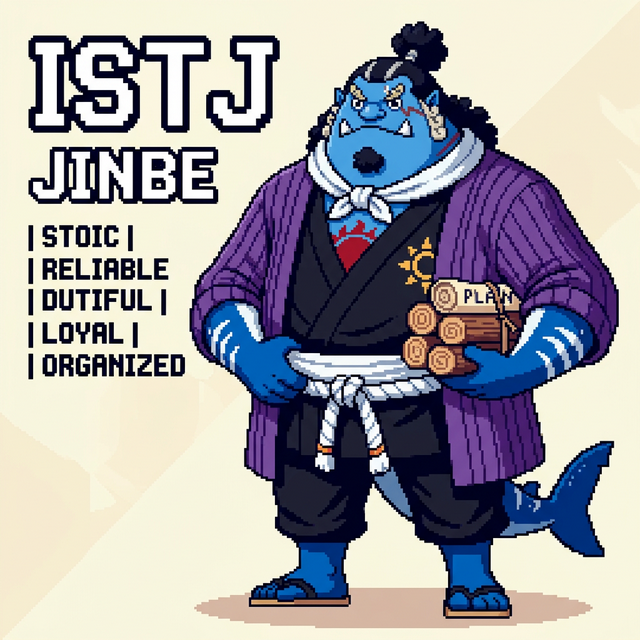
“ISTJ types prioritize reliability, duty, and consistency while balancing goals and relationships.”
This result is entertainment content inspired by anime stories. Use it as a self-reflection guide, not a clinical diagnosis.
After Marineford, he reminded Luffy to count what he still had and stand up again.
Jinbe's defining scene reflects how ISTJ tendencies appear in real choices. The same reliability, duty, and consistency pattern shows up when pressure rises: keeping a personal standard, protecting key relationships, and acting with consistency instead of impulse.
Jinbe feels like a ISTJ because their repeated choices in the One Piece world show the same decision pattern. Even under stress, they return to a clear internal standard, build trust through actions, and prioritize responsibility over impulsive heroism. This consistent behavior mirrors the ISTJ decision flow and makes the match feel believable.
reliability, duty, and consistency
ISTJ types are often associated with reliability, duty, and consistency. They tend to make choices through a consistent internal framework and shine when their strengths are clearly defined. Use this as a reflection guide rather than a rigid label.
ISTJ types tend to act from a consistent internal standard. The focus on reliability, duty, and consistency shapes how decisions are made and how relationships are managed. When pressure rises, clarity and pacing matter most. Learning to balance personal standards with external expectations leads to more stable outcomes.
🔥 Core Motivation
ISTJ types feel most energized when they can fully express reliability, duty, and consistency. Satisfaction runs highest when their choices align with their values and contribute meaningfully to goals or relationships.
⚡ Watch-Out Pattern
Stress tends to rise when their judgment is ignored or expectations clash with reality. Recognizing this reaction pattern helps them stay more flexible when conflict arises.
Decision Style
ISTJ usually makes decisions through a stable internal framework centered on reliability, duty, and consistency.
Relationship Pattern
They build trust through consistency and clearer priority-setting than reactive responses.
Stress Pattern
Under pressure, rigid standards or over-analysis can increase. Pacing and clarity become critical.
Growth Focus
Balancing logic and emotional context improves both collaboration quality and long-term outcomes.
✨ When This Type Shines
Compatibility isn't about a perfect match. The strongest synergy happens when different personalities connect as complementary roles.
Compatibility Snapshot
With emotion-led partners, start with acknowledgment before jumping to solutions.
ISTJ types can form complementary relationships with people who bring different energy. Rather than viewing differences as friction, treating them as role-division hints leads to stronger, more satisfying bonds.
💬 Talking with This Type
📌 Relationship Principle
No type combination is inherently good or bad. What matters is recognizing that different types may have different judgment criteria and energy management styles — and choosing to learn from those differences. The compatibility insights here are a practical guide to understanding how different personalities can work together, not a definitive match score.
MBTI is a lens for self-understanding, not a verdict. Treat your result as a starting point for exploration, not a final label.
MBTI's 4 Preference Dimensions
Energy Direction
Extraversion (E) / Introversion (I)
Do you recharge with people, or through solitude?
Information Intake
Sensing (S) / Intuition (N)
Do you focus on concrete facts, or patterns and possibilities?
Decision Making
Thinking (T) / Feeling (F)
Do you prioritize logic and objectivity, or values and relationships?
Lifestyle
Judging (J) / Perceiving (P)
Do you prefer structure and decisions, or flexibility and openness?
This result interprets your response patterns through MBTI's four axes (E/I, S/N, T/F, J/P). A 4-letter type is a summary of relative preference patterns, not a permanent identity. The same person may get different results in different contexts — which is completely natural.
MBTI is widely used in education and workplace settings, but psychometric studies have noted limitations around dichotomous scoring and retest consistency. Use this result for self-reflection and communication improvement, not clinical diagnosis. For a more precise picture, consider cross-referencing with validated models like the Big Five.
Show your character match to friends.